Vaccinations

What happens at my new babies appointment for first time parents

Vaccination appointments take around 10 to 15 minutes. You will need to bring your baby’s red book with you. Dress your baby in clothes that are easy to remove – babies under 12 months have injections in the thigh. Dress toddlers and older children in loose or short sleeves – they’ll have their injections in the upper arm.

Vaccines are usually given by the practice nurse. The nurse will explain the process, any potential side effects and what to do if they happen. You can ask as many questions as you want, and you then decide if you want the vaccination to go ahead.

The nurse will carry out several checks before giving the vaccine to make sure that everything is correct. Afterwards, the nurse will record the vaccination in your baby’s red book and on their medical record.

Time of day

If possible, try to avoid making the appointment at a time when your baby could be getting tired and grizzly.

The cuddle

Between 2 and 6 months a cradled position can be most comfortable for your baby during the vaccination.

Your baby may prefer to face in one direction over the other. If your clothing is appropriate, a hold which allows skin-to-skin contact can be very reassuring for your baby.

Comfort

If you are breastfeeding, you can feed your baby while the nurse is giving the vaccine. Breastfeeding releases positive hormones and is calming for babies. If your baby is bottle fed, you could give them a dummy, along with a cuddle to help calm both you and your baby.

Just before and during the injection, it can be helpful for you to chat to the nurse about something other than the vaccination. The sound of your voice will help to calm and reassure your baby.

After the injection, you can gently stroke near the injection site for approximately 10 seconds to provide comfort and distract from any sensations of pain.
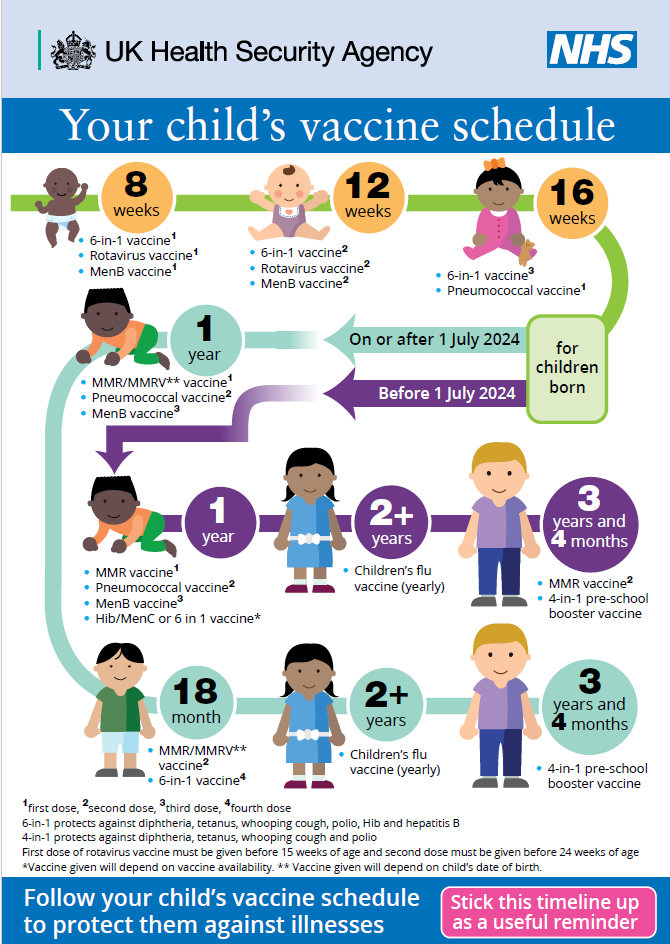
 

8 weeks Child Vaccination

  • 6 in 1 vaccine  (1st dose) diptheria, tetanus, whooping cough, polio, Hib and Hepatitis B 
  • Rotavirus vaccine (1st dose) 
  • Meningitis B vaccine (1st dose) 

6-in-1 Vaccine | Vaccine Knowledge Project

Rotavirus Vaccine | Vaccine Knowledge Project

MenB Vaccine (Meningococcal B Vaccine) | Vaccine Knowledge Project

12 weeks Child Vaccination

  • 6 in 1 vaccine (2nd dose) diptheria, tetanus, whooping cough, polio, Hib and Hepatitis B 
  • Rotavirus vaccine (2nd dose) 
  • Meningitis B vaccine (2nd dose) 

6-in-1 Vaccine | Vaccine Knowledge Project

Rotavirus Vaccine | Vaccine Knowledge Project

MenB Vaccine (Meningococcal B Vaccine) | Vaccine Knowledge Project

16 weeks Child Vaccination

  • 6 in 1 vaccine (3rd dose) diptheria, tetanus, whooping cough, polio, Hib and Hepatitis B 
  • Pneumococcal Vaccine (1st dose) 

6-in-1 Vaccine | Vaccine Knowledge Project

Pneumococcal Vaccine | Vaccine Knowledge Project

1 Year Child Vaccination

18 Months Child Vaccination

  • 6 in 1 vaccine (4th dose) for children born on or after 1st July 2024 
  • MMRV (1st or 2nd dose) for children born on or after 1st July 2024 

6-in-1 Vaccine | Vaccine Knowledge Project

MMRV Vaccine (Measles, Mumps, Rubella, And Varicella Vaccine) | Vaccine Knowledge Project

3 Years and 4 Months Child Vaccination

  • 4 in 1 pre-school booster vaccine 
  • MMRV (1st or 2nd dose) for children born between 1st September 2022 and 31st December 2024

Pre-school Booster | Vaccine Knowledge Project

MMRV Vaccine (Measles, Mumps, Rubella, And Varicella Vaccine) | Vaccine Knowledge Project

12 to 13 years Vaccine

Vector sets of cartoon characters each ...

  • HPV Vaccine given in school between 12 and 13 years 

HPV Vaccine (Human Papillomavirus Vaccine) | Vaccine Knowledge Project

14 Year old Vaccination

Vector sets of cartoon characters each ...

  • 3 in 1 Teenage booster Tetanus, Diptheria, Polio 
  • Vaccinated at school 

Teenage boosters (Tetanus, diphtheria and polio (Td/IPV)) | Vaccine Knowledge Project

Page last reviewed: 11 March 2026
Page created: 04 March 2026